Christopher Guly
The Ukrainian Weekly
OTTAWA – After U.S. President Donald Trump accused his Ukrainian counterpart of being a “dictator without elections” and warned Volodymyr Zelenskyy in a Truth Social post that he “better move fast or he is not going to have a Country left,” American and Russian officials began peace talks in Saudi Arabia, while shortly after Canadian Prime Minister Justin Trudeau insisted that such negotiations must include Ukrainian representation.
“It’s a fundamental principle for Canada, and for the vast majority of our allies, that nothing about Ukraine without Ukraine,” he said at a February 19 news conference in Montreal.
“Ukrainians have been fighting and dying – not just to protect their sovereignty [and] territorial integrity,” said the prime minister, who attended a peace and security summit in Kyiv with 12 other world leaders on February 24 as Ukraine marked the third anniversary of Russia’s invasion. It was Mr. Trudeau’s fourth visit to the country since the full-scale war began.
“They’re also fighting to protect the rules-based order that keeps us all safe around the world and has for close to 80 years now,” the prime minister said at his February 19 press conference.
“This period of peace, stability, prosperity for the world happens because we had rules around borders, around not invading your neighbors, that Russia chose deliberately to violate a number of years ago,” he added.
Mr. Trudeau said that “puts at risk not just Ukrainians’ ability to determine their own future,” but that “it puts at risk all of our democracies, all of the rules that keep us safe and prosperous.”
“That is why Canada and our allies are unequivocal on standing up against [Russian President] Vladimir Putin’s illegal, immoral, unjust violations of the international order,” the prime minister told reporters.
The following day, Mr. Trudeau spoke to Mr. Zelenskyy, and, according to a readout from the prime minister’s office, told the Ukrainian leader that “Canada will always stand in defense of Ukraine and [Mr. Trudeau] emphasized that there can be no sustainable peace in Europe without security for Ukraine.”
On February 18, in a virtual news conference from Brussels, Canadian Foreign Affairs Minister Mélanie Joly said that Canada would like to play a peacekeeping role in Ukraine whenever the war with Russia ends.
“We want to be part of these conversations regarding security guarantees,” she said. “We want to be part of conversations linked to more Canadians being involved in protecting Ukraine.”
Ms. Joly, who took part in the Munich Security Conference, which Mr. Zelenskyy also attended, said that “many Canadians have been inspired by what is going on in Ukraine because we know they’re fighting for the right reasons.”
“We can’t let Russia go unchecked,” she said.
Canadian parliamentarians were also in Brussels to attend the North Atlantic Treaty Organization (NATO) Parliamentary Assembly’s Defense and Security, Economics and Security, and Political committee meetings in mid-February.
In a statement, Canada’s delegation said that it told the assembly that “Canada stands with Ukraine and insists that any peace plans include the full participation of Ukraine and Europe – and we reaffirmed our support for the territorial integrity of Ukraine.”
“Now is not the time to be silent on any attempts to undermine the international rules-based order,” said the Canadian NATO Parliamentary delegation, which was included five members of Parliament and five senators representing different political parties and groups.
Former Canadian Foreign Affairs Minister Lloyd Axworthy is among prominent Canadians who have raised their voice in support of Ukraine.
“Ukraine may soon find itself outmuscled,” he wrote in a February 19 Globe and Mail commentary. “If Mr. Trump and Mr. Putin negotiate a settlement, Ukraine could be forced into territorial concessions or a weakened sovereignty.”
“This should serve as a wake-up call for Canada,” said Mr. Axworthy, who in his commentary highlighted the threat of annexation from Mr. Trump, “who seeks to erode our sovereignty and absorb us into his imperfect union.”
“Ukraine’s struggle shows the dangers of underestimating authoritarian threats, of relying too much on U.S. protection, and of failing to build strong alliances,” he said.
In a February 19 statement, Ukrainian Canadian Congress (UCC) President Alexandra Chyczij called Mr. Trump’s accusation that Ukraine started the war with Russia, which she characterized as a “genocidal invasion, … as revolting as it is false.”
“[Mr.] Trump’s insults” and his “undermining of Ukrainian sovereignty will only encourage Russia to further aggression against Ukraine and Ukraine’s neighbors,” she said.
“[Mr.] Trump has demonstrated that he is a willing instrument of the Kremlin and the war criminals who run Russia today,” she said.
In an interview, Ms. Chyczij told a correspondent for The Ukrainian Weekly that she didn’t believe Ukraine or the European Union “would accept a deal that the Americans negotiate.”
She said that “for someone who calls himself a master of the art of the deal,” Mr. Trump’s “negotiating strategy is quite weak.”
“He’s got nothing left to give, unless his intention all along was to give the store away,” she said.
She added that the “average Ukrainian is shocked by the position of the Trump administration” and feels “betrayal and fear about what the future holds.”
Members of Mr. Trump’s cabinet have pushed Ukraine into making concessions.
On a February 12 visit to Kyiv, U.S. Treasury Secretary Scott Bessent presented the Zelenskyy administration with a proposal that Ukraine provide the U.S. government with 50 percent of the revenue from some key Ukrainian resources, including minerals, oil and gas, since the U.S. “has provided significant and material support to Ukraine since Russia’s invasion of Ukraine in Feb. 2022,” according to an apparent draft document reviewed by ABC News.
Mr. Zelenskyy refused to sign the deal, and at a February 19 news conference in the Ukrainian capital, he said: “I told them to show the security guarantees, and then we talk about the percentage. They said 50 percent and I replied, no. I can’t sell the country off.”
“Besides, around 20 percent of resources are in Russia-occupied territory,” the president added.
Meanwhile, during a February 13 news conference in Brussels, following a NATO defense ministerial meeting, U.S. Defense Secretary Pete Hegseth said that “returning to Ukraine’s pre-2014 borders is an unrealistic objective,” referring to Russia’s initial invasion of Ukraine when it seized the Crimean Peninsula and portions of the Donbass in Ukraine’s east. At a news conference a day later, Mr. Hegseth walked back that assertion when he said that “everything is on the table.”
Ms. Chyczij expects that it will be “a tough sell for the Ukrainian military – a tough sell for every Ukrainian family who has lost someone in this war to accept what essentially looks like capitulation. They will ask themselves ‘What have we spent the last three years doing?’”
She said that, if “U.S. military aid is not replaced with increased European military aid,” a “concession of sorts” could result.
“But it will not be a long-lived one,” said Ms. Chyczij, who was in Kyiv last June as part of a Canadian government trade mission.
“You will have a million veterans of the war with military experience and weapons, and you could see an insurgency that you’ve never seen before,” she said, noting that such a scenario played out following the end of World War II when the Ukrainian Insurgent Army fought against the Soviet Union until 1949.
If there is any ceasefire, “Putin will not respect” it, Ms. Chyczij said.
She added that “there is no universe in which Putin will respect a ceasefire. He’s not going to be satisfied with just Donbas and Crimea. His stated goal has been [to claim] all of Ukraine and in fact the reconstitution of the USSR. I don’t think there any prospects for peace in any event. So, for that reason alone, the fighting will continue.”
That outcome could also “demonstrate to [Mr.] Trump that Putin has fed him a bunch of lies” and “had no intention of abiding [by] any peace agreement,” said Ms. Chyczij, who has family members in western Ukraine.
She explained that for the UCC the ongoing war has created the sizable challenge of supporting as many as 300,000 displaced Ukrainians in Canada “who are facing the expiration of their work permits” and “many in government may have believed [Mr.] Trump would broker some form of peace deal that would allow Ukrainians to return home.”
“This has been a rude awakening for our immigration department that this may not happen soon [and] that [Mr.] Trump is not a reliable partner,” she said.
On the positive side, the Canada-Ukraine Foundation (CUF) has raised about $67 million in cash and in-kind donations (in the form of equipment) for humanitarian aid to Ukraine since the war began three years ago. The support has helped more than six million people in Ukraine through food assistance, medical aid, shelter and “other life-saving support,” according to the CUF, the largest Ukrainian-Canadian charitable organization.
However, the foundation faces its own challenge to help fill in the gap left by the Trump administration’s plan to shut down the U.S. Agency for International Aid (USAID), which provided Ukraine with $37.6 billion in humanitarian aid, development assistance and direct budget support since the start of Russian’s full-scale invasion.
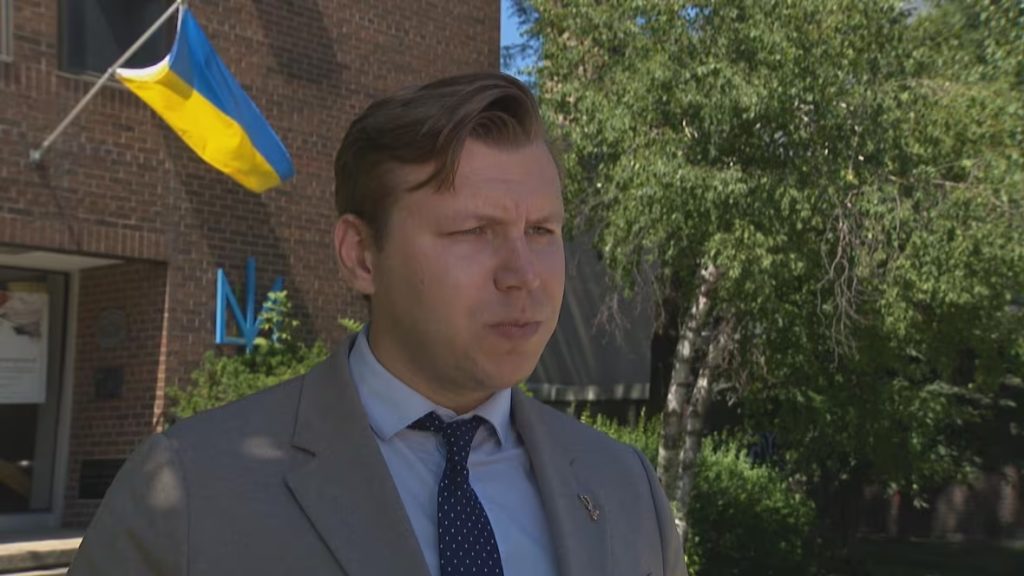
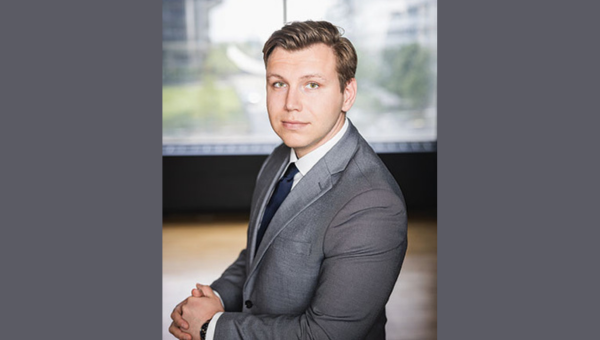
“Over the last couple of weeks there’s been a significant amount of organizations in Ukraine that have relied heavily on the support from USAID, which has been cut – and they are now looking for other avenues,” said Ukrainian-born Valeriy Kostyuk, executive director of the CUF, who added that he did not know the extent of the reduction in American humanitarian support for Ukraine.
“From the standpoint of the Canada-Ukraine Foundation, we have to increase our capacity to fundraise and deliver aid to Ukraine quickly and efficiently because there are a lot of gaps to fill,” he said.
Within the humanitarian-aid community, “the United States is becoming viewed as being unreliable,” Mr. Kostyuk said.
On February 13, the CUF launched an “Even the Brave Struggle” campaign to address the psychological toll the protracted war has had on people.
“The mental-health injuries that Ukrainians are currently developing are becoming deeper and deeper as they’ve been pushing off the Russians for three years, and right now Ukraine’s number one ally is changing its rhetoric 180 [degrees],” said Mr. Kostyuk, a former theatrical and cultural projects producer who has lived in Canada for nearly two decades but has family in Ukraine.
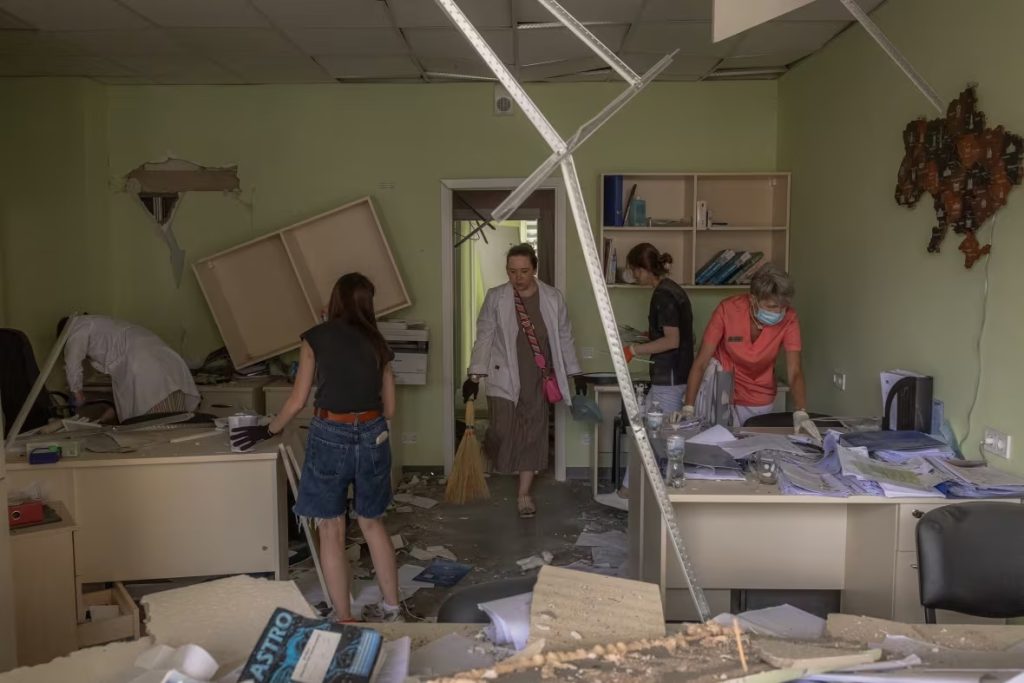
“My closest people cannot sleep at night because of Russian attacks,” he said about Russia’s mid-February massive drone attack on his hometown of Odesa that cut power and heating to nearly 90,000 residents of the city located in Ukraine’s south.
“It’s quite an intimidating thought to live with that someone’s rhetoric or decision can take away an opportunity for me to keep going home,” Mr. Kostyuk said of Mr. Trump’s talk on Ukraine, adding that his “worst nightmare” is that Russia could completely control the country he visits regularly to swim in the Black Sea and where he enjoys “a pint of local beer from one of my favorite microbreweries.”
“Some of my friends had to leave Odesa; some of my relatives had to leave Ukraine,” he said. “I had to move my grandmother to Toronto, and she lives not too far away from me now.”
But Ukraine is not in an entirely hopeless situation, according to Ms. Chyczij.
The $300 billion in Russian assets seized by the West could be repurposed to reconstruct the country.
She said that Ukraine is also developing its own military industrial complex, including homegrown drone manufacturing that could both allow the country to become more self-sufficient on the defense front and become a major military supplier within Europe.
Mykhailo Fedorov, Ukraine’s first deputy prime minister for innovation, education, science and technology, told CBC News that the country produced more than 1.5 million unmanned aerial vehicles (UAVs) last year.
A recent report by two research fellows at the London-based Royal United Services Institute for Defense and Security Studies found that Ukrainian tactical UAVs have accounted for between “60 and 70 percent of damaged and destroyed Russian systems.”
In terms of Canada’s relationship with Ukraine, Ms. Chyczij said that “Prime Minister Trudeau and Foreign [Affairs] Minister Joly have set the tone by stepping up and speaking in defense of President Zelenskyy and reaffirming Canada’s support for Ukraine.”
Mr. Trudeau’s term as prime minister and leader of the Canadian Liberal Party ends on March 9 when his successor will be named following a Liberal leadership race that includes former deputy prime minister Chrystia Freeland – a Ukrainian Canadian and vocal defender of her ancestral homeland – and Mark Carney, the former governor of the central banks of England and Canada, who is the frontrunner in the contest.
Canadians could also be headed for a general election this spring should the Liberal minority government fall in a vote of non-confidence in the House of Commons. Based on recent polling numbers, the Official Opposition Conservatives, under their leader, Pierre Poilievre, would form a majority government.
Ms. Chyczij said that she has had “one 15-minute meeting” with Mr. Poilievre.
“He listened but was non-committal, and we have been waiting for a platform on how the Conservatives would support Ukraine,” she said.
On February 24, 2024, at a rally in Hamilton, Ontario marking the second anniversary of the Russian invasion of Ukraine, Mr. Poilievre said that the Conservatives would “continue to stand with the Ukrainian people against the illegal, unjustifiable and ego-driven bloodshed initiated by Vladimir Putin.”