
Category: CUF In the news (show on home section)
Canadian-Based Charity Surpasses $100 Million in Humanitarian Aid to Ukraine since Russia’s full-scale invasion
News Release
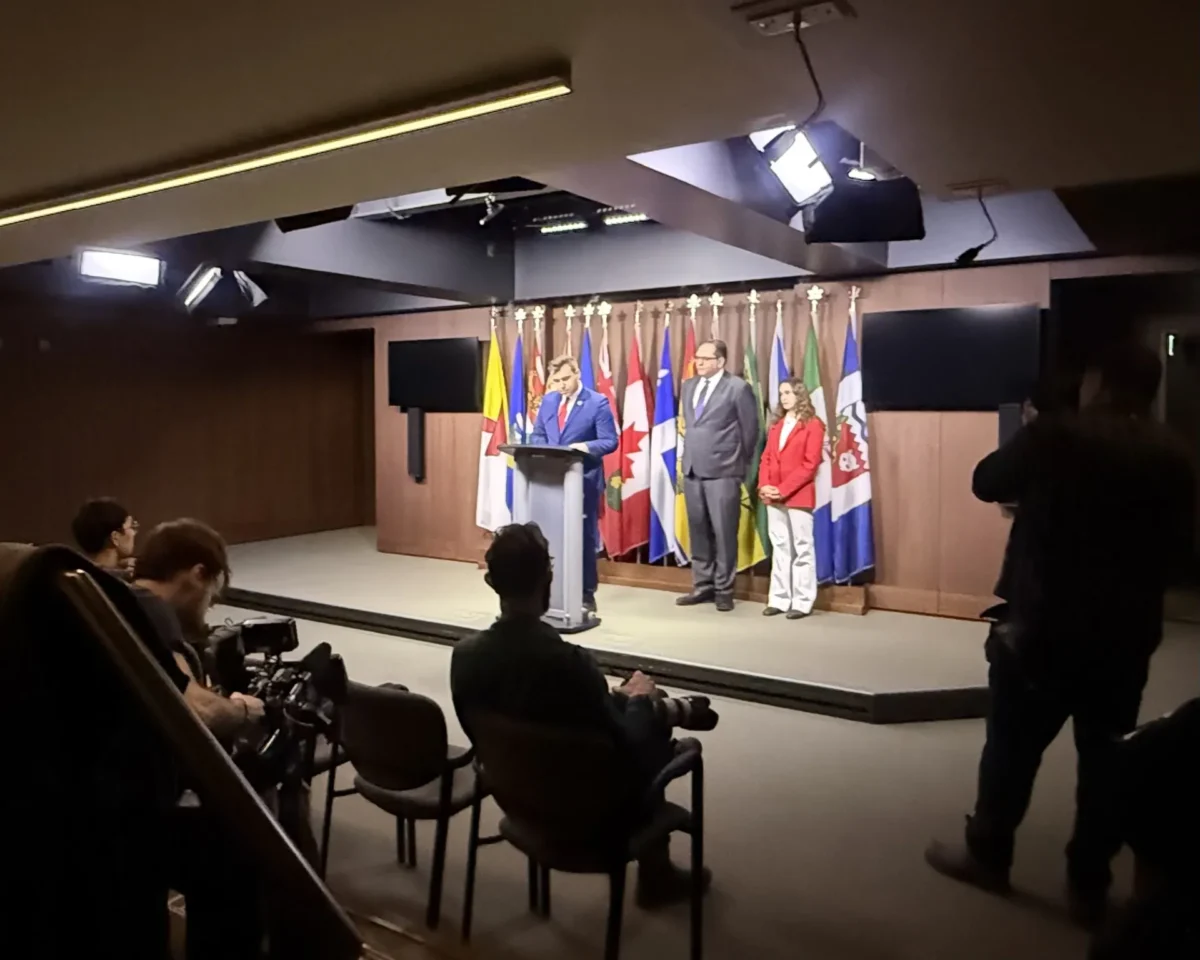
OTTAWA (February 23, 2026) – On the eve of the 4th anniversary of Russia’s full-scale invasion of Ukraine, the Canada-Ukraine Foundation (CUF) calls on the Government of Canada to match, dollar-for-dollar, all private donations to CUF in 2026 to support its work in humanitarian assistance for Ukraine.
CUF announced today that since Russia launched a full-scale invasion of Ukraine on February 24, 2022, it has surpassed more than $100 million CAD in funds raised and deployed for humanitarian assistance to Ukraine.
Funds raised in Canada through the Ukraine Humanitarian Appeal, a joint initiative of the Canada-Ukraine Foundation and the Ukrainian Canadian Congress, have been deployed to date to support a broad range of humanitarian projects, including:
- Food and water for displaced Ukrainians
- Hygiene kits and blankets for refugees
- Medical equipment
- Home heating equipment
- Power generators
- Surgical missions with Canadian reconstructive physicians
- Support to hospitals and medical infrastructure bombed by Russia
- Civilian demining
- Psychological and trauma support
“Recovery doesn’t start after a ceasefire. It is an ongoing process. Today. Every day. It can’t wait for the war to end.”
– Andrew Maleckyj, Chair of the Board of the Canada-Ukraine Foundation
“This war is a systematic violation of humans’ rights to live peacefully, speak their own language, go to school, run their business, enjoy their own culture and come home to their kids, safely and alive. It is a brutal attempt at ethnocide on a scale we have not seen in the West since the Second World War.”
– Valeriy Kostyuk, Executive Director of the Canada-Ukraine Foundation
“Russia’s bombing of Ukrainian energy infrastructure is forcing hundreds of thousands of Ukrainians to live without heat, electricity or water in the coldest winter on record. Russian terror against Ukrainian civilians must be met with a strong response from world leaders.”
– Alexandra Chyczij, National President, UCC
“The Ukrainian Canadian community expresses its solidarity and admiration for the courageous Ukrainian Armed Forces, who bravely defend their country and Ukrainian First Responders who work around the clock to restore power to Ukrainian cities. The severe humanitarian crisis caused by Russian bombing of Ukrainian civilians has created urgent needs to which the community here is working hard to respond.”
– Ihor Michalchyshyn, UCC CEO and Executive Director
“The destiny of democracy is unfolding on the battlefields of Ukraine. Supporting Ukraine is not an act of charity – or even just an act of solidarity. It’s enlightened self-interest. This war either stops in Ukraine, or it spreads deeper into Europe or over the Arctic. The sooner Russia is stopped, the lower the cost – in both lives and money.”
– Ihor Michalchyshyn, UCC CEO and Executive Director
“If average Canadians have been investing their own hard-earned after-tax dollars in supporting Ukraine – in the midst of an affordability crisis – we are asking the Government of Canada to do the same and match Canadians’ efforts, dollar-for-dollar, to the Canada-Ukraine Foundation in 2026.”
– Valeriy Kostyuk, Executive Director of the Canada-Ukraine Foundation
“Canada has become home for me since the full-scale invasion, but all my family is in Ukraine. This winter I went back for Christmas and a few days after I arrived nine missiles deliberately targeted the power plant in my city – there was not any heat, no light, no water and children knocked on our door begging for a cup of hot tea.”
– Marichka Bokovnia, displaced Ukrainian and documentary producer
“It’s one thing to prepare for war, it’s another to wake up to it. I was studying political science when my city was attacked and my hopes and dreams were shattered. From one day to the next, the wars I was learning about became a reality and my life took a completely different path. I am grateful to Canada for giving me a place to live and study in safety – but I will never take that safety for granted.”
– Sofiia Ringis, displaced Ukrainian and Ottawa-based student
Quick Facts
- The Ukraine Humanitarian Appeal was launched in January 2022 as a joint initiative by the Canada-Ukraine Foundation and the Ukrainian Canadian Congress in anticipation of massive humanitarian assistance need in the event Russia launched a full-scale invasion of Ukraine.
- The Ukraine Humanitarian Appeal is managed by the Canada-Ukraine Foundation. Within four days of the full-scale invasion on February 24th, 2022, the Canada-Ukraine Foundation started to deploy critical humanitarian supplies into Ukraine to help civilians impacted by Russia’s war.
- Over the four years since the launch of Russia’s full-scale invasion against Ukraine, CUF has raised and deployed more than $100 million in humanitarian assistance to Ukraine.
- The majority of these funds have been raised from Canadians at-large, with no ancestral link to Ukraine, demonstrating broad public support for assistance to Ukraine.
- The Ukraine Humanitarian Appeal has supported more than seven million people through over 400 projects implemented with partners on the ground in Ukraine.
- The Canada-Ukraine Foundation is a registered charity under the laws of Canada and has been operating since 1995.
Toronto, ON – November 27, 2025 – After conducting medical missions in Poland since Russia’s full-scale invasion in 2022, the Canada Ukraine Surgical Aid Program (CUSAP) returned to Ukraine this fall. A humanitarian initiative led by its founder and surgical lead, Dr. Oleh Antonyshyn, the 18th CUF-CUSAP missions provided complex reconstructive surgeries for Ukrainian veterans and civilians injured in the war, marking a significant milestone in restoring access to advanced surgical care inside Ukraine.
“To be back on Ukrainian soil, working side by side with our colleagues again, was profoundly meaningful,” said Dr. Oleh Antonyshyn, MD FRCSC. “Our CUSAP surgical teams completed 52 major reconstructive operations, 9 of them being microsurgical free flaps, and 88 consultations in just 12 days. It was our most efficient and cohesive missions to date, demonstrating the resilience and professionalism of both the Canadian and Ukrainian medical teams.”
The surgical teams operated in partnership with Sunnybrook Health Sciences Centre, the Ukrainian Ministry of Health, the Lviv-Clinical Municipal Communal Emergency Hospital (Unbroken Centre for Rehabilitation) and the Volyn Regional Clinical Hospital in Lutsk.
The missions included orthopedics, reconstructive craniofacial surgeries, neurosurgery, microsurgery, plastic surgery, anesthesia, and nursing specialists, focusing on training local surgeons and building long-term capacity in advanced trauma care.
“The need for orthopedic and reconstructive expertise is staggering,” said Dr. Michelle Hladunewich, MD, MSc FRCPC . “Our return to Ukraine isn’t just about providing immediate surgical relief, it’s about transferring knowledge and strengthening the systems that will support thousands of future patients who have survived devastating injuries.”
The fall 2025 CUSAP missions were made possible through the support of donors to the Canada-Ukraine Foundation (CUF) and its partners. CUF led a national fundraising campaign this fall that raised more than $1,000,000 CAD for medical programs, which will enable CUSAP to plan additional missions to address craniofacial and extremity post-trauma deformities in civilian and military casualties of war.
“CUSAP missions demonstrate what Canadian support makes possible,” said Valeriy Kostyuk, Executive Director of the Canada-Ukraine Foundation. “Every contribution goes directly to surgical care, training, and the recovery of those who have given everything for Ukraine’s freedom. Returning CUSAP to Ukraine signals both trust and progress, proof that our collective efforts are helping rebuild the country’s medical resilience.”
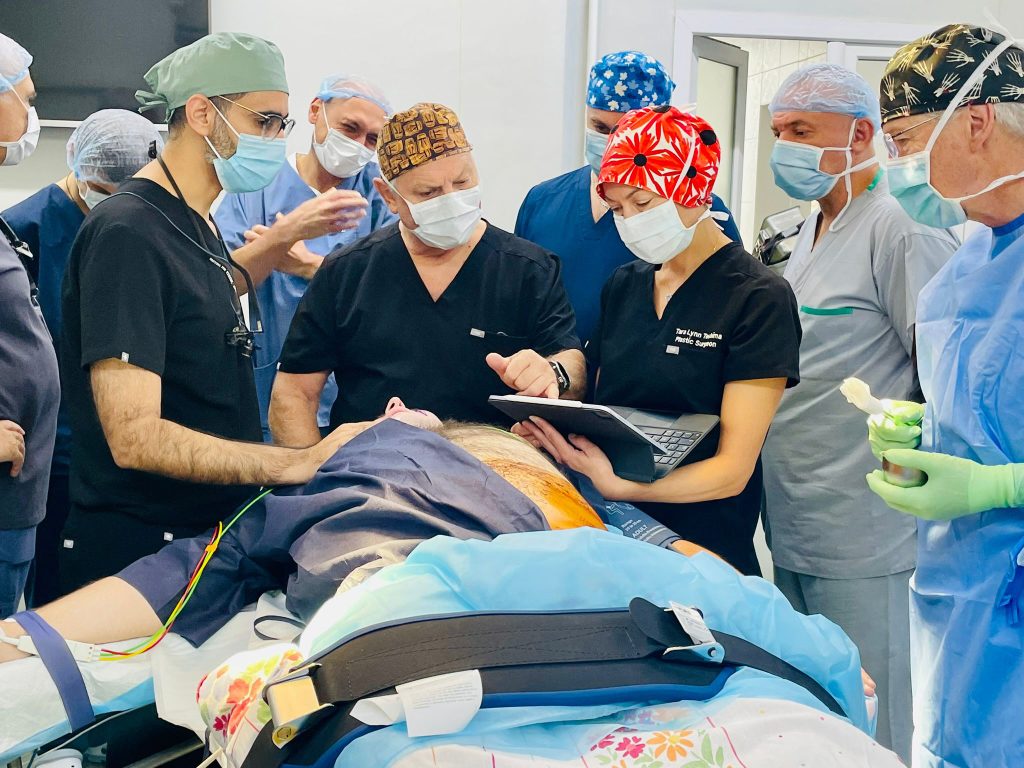
CUSAP, established in 2014 under the leadership of Dr. Oleh Antonyshyn and CUF, has now completed 18 surgical missions, treating thousands of patients and performing hundreds of reconstructive operations for victims of war. Each mission includes extensive training components, ensuring the transfer of advanced surgical techniques to Ukrainian doctors and sustaining medical excellence long after the teams return home.
To learn more about CUF and to donate to fund reconstructive surgical missions and empower Ukraine’s healthcare workers with the tools and resources they need to save lives, please visit cufoundation.ca.
Social Media:
Instagram: @canadaukrainefoundation
Facebook: @cufoundation
YouTube: @canada-ukrainefoundation2010
Media Contacts:
Zai Karim [email protected] – 647-983-6669
Shannon Kenney [email protected] – 416-770-0359
About the Canada-Ukraine Foundation
Founded in 1995 during the 18th Ukrainian Canadian Congress (UCC), the Canada-Ukraine Foundation (CUF) was established to coordinate, develop, and deliver humanitarian assistance from Canadians to Ukraine. CUF continues to play a vital role as a national charitable foundation, working to monitor, promote, and support humanitarian aid initiatives. Its mission includes evaluating projects, fostering collaboration among aid providers, setting strategic priorities, and ensuring resources are directed where they can have the greatest impact. CUF also serves as a forum for individuals and organizations—across community, private, and public sectors—committed to supporting Ukraine. In addition to its work abroad, CUF also supports related initiatives within Canada. cufoundation.ca
About CUSAP
The Canada Ukraine Surgical Aid Program – CUSAP is a humanitarian surgical aid initiative that provides life-changing care to patients affected by the war in Ukraine. The surgery mission model is based on the organization and mobilization of a self-sufficient multidisciplinary surgical team comprising all requisite staff, surgical hardware and supplies. The goals of the program are to provide comprehensive state-of-the-art multidisciplinary trauma care and post-trauma reconstruction to both civilian and military casualties of war in Ukraine, and to provide support to Ukrainian health care professionals through education in trauma reconstruction.
Published: November 04, 2025 at 6:03PM EST
The Sudbury Catholic District School Board is currently hosting the Holodomor National Awareness Tour, a national educational program, at its secondary schools.
A state-of-the-art mobile classroom was stationed at St. Benedict Catholic Secondary School on Tuesday, offering students an immersive historical experience.
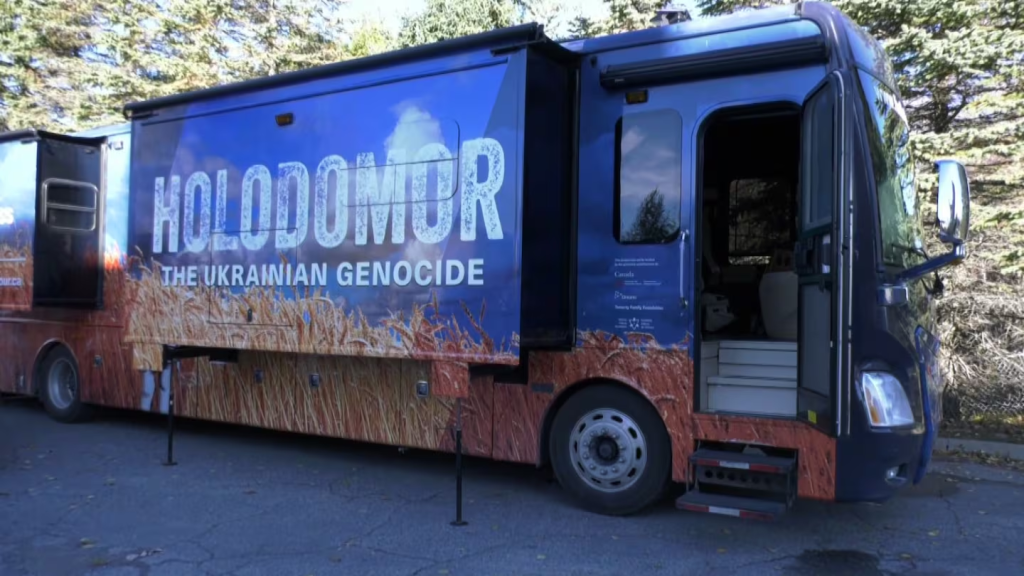
Immersive, captivating educational tool
Educators praised the tour’s unique approach to teaching this difficult chapter of history. History teacher James MacNeil highlighted the program’s dynamic nature and its impact on students.
“It’s a mix of dramatic portrayals of some key individuals who were heroic in the face of oppression 90 years ago, and then allows students to offer their opinion, both on those issues as well as what’s taking place in our world today,” MacNeil said.
“It really is captivating for them on a couple of different levels, ways that we can’t achieve in the classroom.”
Student reaction to a once-censored history
Approximately 100 students participated in an interactive session focused on the Holodomor, the genocide that occurred in Ukraine between 1932 and 1933. For many, like grade 10 student Felix Quinn, the presentation was their first exposure to the event.
“I’ve never heard about the Holodomor until now,” he said.
“I think it’s something that needs to be talked about more, because it definitely was censored a lot more than it should have been. But I think it really opened my eyes and I think I am going to try to learn more about what is happening in this world.”
“I really enjoyed it and I think my classmates did as well,” added Quinn.
Empowering future leaders through historical lessons
Developed by the Canada-Ukraine Foundation in 2014, the national tour has educated over 70,000 students across the country.
The project’s manager, Roma Dzerowicz, told CTV News that the program’s core mission is to empower youth with knowledge and a sense of civic responsibility.
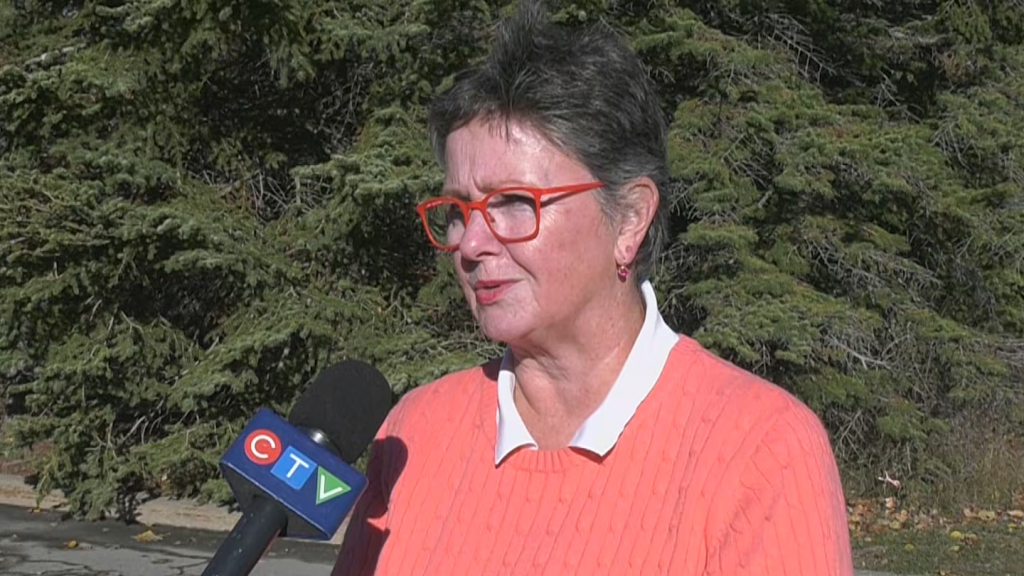
“Students who are the seeds of future leaders and the ones who can make a difference moving forward, can understand what happened, why it happened, but also understand the importance of civility, tolerance, equity, how propaganda fits into the equation today,” said Dzerowicz.
“To understand that they can make a difference if they choose to raise their voices.”
— Roma Dzerowicz, project manager for the Holodomor National Awareness Tour
The mobile classroom continues its tour at St. Charles College and Bishop Alexander Carter Catholic Secondary School later this week.
The general public is also invited to experience the exhibit at the Ukrainian Senior Centre on Notre Dame Avenue on Wednesday evening, from 5 p.m. to 8 p.m.
Toronto, ON – October 16, 2025 – The Canada-Ukraine Foundation (CUF) is proud to announce a $350,000 donation from Canadian-born company Booster Juice, to support life-saving programs for Ukrainians. The contribution directly funds initiatives that provide urgent medical care and aid for displaced families, as well as support for vulnerable children and injured soldiers impacted by Russia’s ongoing war.
This financial contribution underscores Booster Juice’s long-standing commitment to Ukraine. Since 2022, the Canadian company has launched several fundraising efforts that reflect the generosity of Canadians, including in-store donation drives, 50/50 draws, and corporate fundraising campaigns across its nearly 500 stores nationwide. Founder, CEO, and President Dale Wishewan has personally also contributed his time, volunteering alongside his daughter at a refugee centre in Poland during the early days of the full-scale invasion. Dale’s daughter and his son later returned individually to continue volunteering, further exemplifying the family’s deep personal commitment to supporting those displaced by the war.
“We are proud to support the Canada-Ukraine Foundation in delivering critical aid to directly impact and improve the lives of Ukrainians,” said Wishewan. “Though the war in Ukraine may not dominate headlines today, the need for support is greater now more than ever.”
“These funds will sustain programs that save lives, support families, and provide hope for Ukrainians,” said Valeriy Kostyuk, Executive Director of the Canada-Ukraine Foundation. “We are deeply grateful for the generosity of Canadians and companies like Booster Juice who stand with Ukraine in the darkest times.”
This partnership underscores the power of collective action, ensuring that Canadians’ support reaches those who need it most. This generous donation from Booster Juice will support key CUF programs and initiatives that aim to provide much-needed relief in Ukraine.
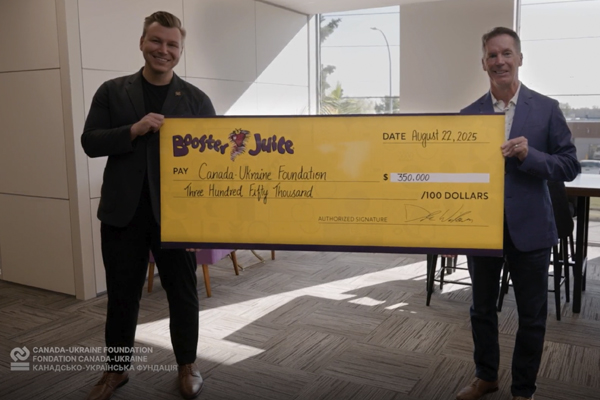
Watch a brief video of the conversation with Booster Juice’s Dale Wishewan and cheque presentation here [https://youtu.be/WPML9st_kVg]
Until November 2, CUF is running a dedicated campaign to fund reconstructive surgical missions and empower Ukraine’s healthcare workers with the tools and resources they need to save lives. To donate and learn more about CUF, please visit www.cufoundation.ca.
Social Media:
Instagram: @canadaukrainefoundation // @boosterjuice
Facebook: @cufoundation // @boosterjuice
YouTube: @canada-ukrainefoundation2010 // @boosterjuice
Media Contacts:
Zai Karim [email protected] – 647-983-6669
Shannon Kenney [email protected] – 416-770-0359
About the Canada-Ukraine Foundation
Founded in 1995 during the 18th Ukrainian Canadian Congress (UCC), the Canada-Ukraine Foundation (CUF) was established to coordinate, develop, and deliver humanitarian assistance from Canadians to Ukraine.
CUF continues to play a vital role as a national charitable foundation, working to monitor, promote, and support humanitarian aid initiatives. Its mission includes evaluating projects, fostering collaboration among aid providers, setting strategic priorities, and ensuring resources are directed where they can have the greatest impact. CUF also serves as a forum for individuals and organizations—across community, private, and public sectors—committed to supporting Ukraine. In addition to its work abroad, CUF also supports related initiatives within Canada.
To learn more: cufoundation.ca
About Booster Juice
As Canada’s original juice and smoothie bar, Booster Juice’s mission is to create long-standing customer relationships by consistently delivering an incredibly delicious, convenient and nutritious product, perfectly suited for an active lifestyle. Since 1999, Booster Juice has been committed to providing customers with food they can feel good about. As a leader of healthy alternatives in the quick-service industry, Booster Juice is always looking for new and innovative products while still maintaining the same exceptional service they have come to be known for. Today, Booster Juice is in every province and territory across Canada – bringing smoothies, fresh-squeezed juices, and delicious food options to active customers on the go. boosterjuice.com
Double Your Impact to Support Ukraine’s Medical Heroes
Get your donation matched from October 7 to 11
Canadian volunteer surgical teams are working alongside Ukrainian medical teams to rebuild lives shattered by Russia’s war. Every surgery restores dignity. Every procedure defies the brutality that caused these wounds. Every patient treated is a testament to the power of compassion over destruction.
Now, you can double your impact.
The Ronald S. Roadburg Foundation is matching all donations to the Canada-Ukraine Foundation’s medical campaign up to $100,000 between October 7-11.
This means every dollar you give becomes two dollars of life-saving medical support.
The Ronald S. Roadburg Foundation, a private charitable foundation established through the estate of late Vancouver businessman Ronald Roadburg, continues to demonstrate extraordinary leadership in supporting humanitarian initiatives across communities worldwide.
Its commitment to strengthening bonds between communities and their unwavering continued support for Ukraine inspires us all.
Your matched donation will fund surgical missions through the Canada Ukraine Surgical Aid Program (CUSAP), deliver critical medical supplies, and support essential medical programs that are giving Ukrainian civilians and veterans a chance to reclaim their lives and their futures.
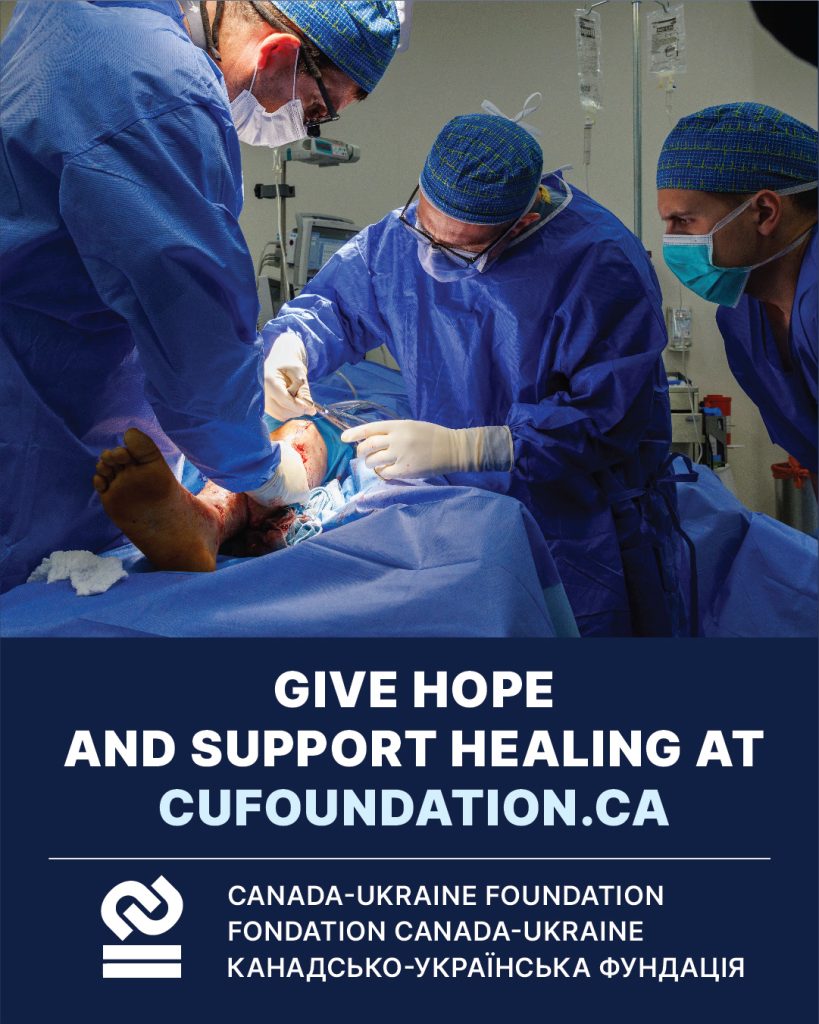
This is your moment to make twice the difference. Between October 7-11, your generosity becomes double the hope, double the healing, double the impact.

Tens of thousands of children are being abducted, stripped of their identity, and taught to hate their homeland
by Sarah Treleaven, Jamie Levin
From The Walrus
A few months before Russia’s 2022 invasion of Ukraine, Nikita was sent to a boarding school in Oleshky, a city in the Kherson region, for orphans and children who require complex care. Around nine years old at the time, he struggled with chronic stomach issues, among other special needs. His grandmother Polina, who had been living in Poland since 2020, supported him; his mother was in a different city in Ukraine, and his father was not even on his birth certificate.
In the fall of 2022, Russian soldiers closed in on Nikita’s boarding school and took the children. When Polina learned what happened, she contacted the school and found that a new director, who was pro-Russian, was now in charge. He told her that Nikita had been sent to Crimea for rehabilitation for a few days. But she later learned that, from Crimea, Nikita had been sent to an orphanage in the Krasnodar region in Russia, and then transferred again to an unknown location. When Polina called the director at the boarding school to find out why, he said it had been determined that Nikita has no family. The suggestion that Nikita had been forcibly taken for his own good seemed to be a sharp slap in the face to the grandmother who had long agonized over his well-being.
“I was completely lost,” says Polina through a translator. (Her story has also been featured on CBS’s 60 Minutes.) “I didn’t know what to do, but I wanted to find my grandson, and I started to write everywhere, to look for someone who can help.”
She came across an organization named Save Ukraine, founded in 2014, which locates and rescues Ukrainian children taken by Russian forces and rehabilitates them once they get home. Save Ukraine took up an investigation on Polina’s behalf, eventually finding Nikita at an institution in occupied Skadovsk, a beach town in southern Ukraine now administered by the Russian military. Polina was terrified at the thought of her grandson living behind enemy lines, in the hands of people who could justify stealing children. And she had no idea how she might get Nikita back.
Separating children from their families has for years been one of Russia’s key tactics in its assault on Ukraine. In 2014, after Russia’s annexation of Crimea, more than ninety Ukrainian children were abducted and later returned. This time, the problem has proven much more intractable, the scale hard to fathom.
Since Russia launched its full-scale attack in February 2022, thousands of vulnerable Ukrainian children, many of whom are orphans or disabled and were living in institutions, are now forcibly held in Russia or under Russian occupation. The numbers vary, but Bring Kids Back UA, an initiative launched by Ukrainian president Volodymyr Zelenskyy, estimates that approximately 20,000 children have been taken. (Bring Kids Back UA partners with civil society organizations such as Save Ukraine.) Others put the number considerably higher. The Humanitarian Research Lab at Yale University believes it to be at least 35,000. Of those taken, according to Bring Kids Back UA, only 1,605 have returned as of this September.
When Russia occupies a slice of Ukrainian territory, officials have attempted to erase Ukrainian identity, offering children Russian passports and embedding them in Russian culture, education, and indoctrination. Younger children have been typically placed in foster care, put up for adoption, or sent to institutional facilities. Older children and teens are often placed in so-called summer camps, where they are taught to be “loyal Russians.” Their forced transfer has been described by the New York Times as a “systematic campaign by President Vladimir V. Putin and his political allies to strip the most vulnerable victims of the war of their Ukrainian identity.”
“We know the names of tens of thousands of children . . . kidnapped by Russia in the occupied territories of Ukraine and later deported,” Zelenskyy said in an address to the United Nations General Assembly in 2023. “Those children in Russia are taught to hate Ukraine, and all ties with their families are broken. And this is clearly a genocide.”
In January 2024, Putin issued a presidential decree that would expedite the process by which orphaned Ukrainian children could receive Russian citizenship. The move appears to be intended to facilitate the adoption process for Russian foster parents. Yale researchers have found 314 children who have been placed in Russia’s adoption and fostering program, and at least 148 of them have appeared on a Kremlin-funded adoption website. The Russian government has begun offering small cash incentives and opened a telephone hotline for prospective adoptive parents. Putin’s children’s rights commissioner, Maria Lvova-Belova, herself adopted a Ukrainian child who was later granted Russian citizenship.
Mykola Kuleba, a former Ukrainian presidential commissioner for children’s rights, has warned of large-scale Russification of Ukrainian children, claiming that 1.5 million of them—representing a fifth of Ukraine’s youth—now live under Russian control, either in occupied territories seized by Russia or in Russia proper, as a consequence of serial Russian annexations dating back to 2014, including Crimea, Luhansk, and parts of Donetsk, Kherson, and Zaporizhzhia regions. Many of these children have found themselves with new parents, a new passport, and speaking a new language. Effecting their return has become a “race against time,” before they are Russified or lost altogether.
Russian authorities have been defiant, painting a more benevolent picture, claiming that their country’s treatment of children has been altruistic. It has called the movement of children “humanitarian missions,” “evacuations,” and “rescues” from supposedly “liberated” territories. Anticipating Ukrainian counterattacks in occupied zones, Russia has even suggested that it is protecting children from Ukrainian authorities or parents who have abandoned them. And it has pointed to the medical care, housing, and other supports it has provided, even filming children for propaganda purposes. In 2022, the Associated Press quoted one Russian woman who had recently fostered three Ukrainian children: “There are children who need to be given affection, love, care, family, mom and dad. If we can give it, why not?”
The Geneva Conventions dictate that children may be temporarily evacuated from war zones to another country, but only for their protection, with the consent of a guardian, and under such conditions that would enable a return to their family. Russian officials claim they facilitate reunification between separated parents and children. But Russia has also been accused of failing to properly keep track of the children it has detained, frustrating efforts to reunite families. Once in Russian custody, many of the children have been moved, sometimes multiple times, making their eventual relocation and recovery more difficult. And communications with people in occupied territories have been frustrated by intermittent power and severed phone lines.
Kuleba now directs Save Ukraine. When we spoke with him in August 2024, over Zoom, he said that Ukrainian children were being groomed to become future soldiers, turned against their homeland, and programmed to help an imperialist Russia gobble up even more territory.
The family reunification efforts by Save Ukraine resemble a mixture of work done by a logistics company, an intelligence agency, and a not-for-profit corporation. Local Ukrainian officials are often in the know about where children have been moved, particularly from one institution to another. Some children self-report their whereabouts, texting, emailing, or calling contacts and revealing their location. Others have been spirited out of the country or territory without the knowledge of Russian authorities—though Save Ukraine declined to discuss those cases in detail.
In almost all instances, there are documents that need to be secured, checkpoints to be navigated, and rockets to be dodged. Tracking down children also requires an underground network of contacts putting themselves at great risk to act as eyes and ears, serving as local fixers for the parents who need transit and somewhere to stay along the way. It costs money and other resources that many of these parents and guardians don’t have. Save Ukraine raises funds from multiple sources, including government funds and donations from the diaspora; in December 2024, the Canada-Ukraine Foundation, a Toronto-based charity, announced that it was donating $220,000 to the organization.
On June 13, 2023, several months after Nikita was snatched by Russian forces, Polina left Poland to find him. She went through Belarus and Crimea on her way to occupied Skadovsk. Save Ukraine had given her a specific narrative to recite when questioned by officials: she must not tell anyone that she was planning to bring Nikita home with her; she must simply say that she was a volunteer aid worker from Poland.
When Polina arrived at the institution, she showed the director the paperwork she had carried that indicated she was Nikita’s grandmother and legal guardian. “No,” he told her, “I’m the director of the institution, so I’m his legal guardian.” He told Polina she would have to do a DNA test to prove that she was even related to the boy. He told her that she should get a Russian passport, and she told him that she didn’t need it—she was living and working in Poland and her grandson was Ukrainian. He warned her that if she didn’t stop pushing back, she would never be permitted to take Nikita. And she would have to leave until they had the results of the DNA test.
Polina told us she saw Nikita before she left: the boy reached his arms out toward her and they hugged. She gave him the presents she had brought, and he asked if he could leave with her. She promised she would come back so they could both leave forever. Polina then had to go, and after tearing herself away from Nikita, she found herself back outside, in an unfamiliar street, in the middle of a war.
Polina told us this story over Zoom late last summer. It was early evening, Kyiv time. Olha Yerokhina, who worked for Save Ukraine until recently, was also on the call, serving as a translator and press secretary. While we waited for Polina to call in, Yerokhina told us that she had only one wish: to sleep.
She would, of course, like to see an end to Ukraine’s war with Russia, to the endless worry, but at that moment, her imminent concern was the loud shelling that keeps her awake in her high-rise apartment. Even when Yerokhina could fall asleep, she would be woken in the night—explosions, gunfire, air-raid sirens, the many apps on her phone pinging about impending rockets, directing her to seek shelter. There were often only a few minutes to find cover. So Yerokhina and her teenage daughter joined some of their neighbours in the long, windowless corridor, their collective fatigue felt in the body even as their minds raced in fear that their building might be hit.
Electricity and water services could be intermittent, but Kyiv was still incongruently, misleadingly functional. Kids went to school, buses were running, people gathered in cafes to commiserate over the war. Soldiers on leave met with friends at familiar restaurants, everyone clinging to some degree of normalcy amidst chaos and destruction that were now all too familiar.
When Yerokhina thinks about an end to the war, she can’t imagine Ukraine ceding any territory, hacking off a limb like there was nothing in the world that mattered. She feels an urgency to talk about Ukraine’s history with her daughter, to instill in her a similar sense of identity and pride. But the war is weighing on Yerokhina’s daughter too. Sometimes, she tells her mom that it’s hard to live in Ukraine. Yerokhina agrees but tells her they need to do what they can to protect it.
Ksenia Koldin was seventeen when Russia invaded and occupied parts of the Kharkiv region in northeastern Ukraine. She and her brother Serhii, then ten, had been placed in foster care months earlier after their mother lost parenting rights. They then found themselves separated from each other: Ksenia, who recounted her story to us through Yerokhina, was sent to study in Russia, while Serhii was relocated to one of the so-called summer camps operated by Russian authorities, then moved several more times, finally to be placed with a Russian foster family.
Ksenia was determined to get Serhii back and return with him to Ukraine. But when she finally tracked him down, she says, the Russian foster mother told Ksenia that she was not going to let Serhii just go with her. Ksenia would have to engage the local social workers and fight to prove that she was Serhii’s family and that he belonged with her.
When Ksenia finally saw her brother with the Russian social workers assigned to his case, she says, he was like a stranger, a shell. He would barely look at her, his eyes cast down as he played with the zipper on his sweatshirt. Ksenia tried to appeal to him directly, but he barely acknowledged her. She asked to take him for a walk so they could get some ice cream, but she was told that wasn’t allowed. She did, however, get to speak with him privately.
When she did, Serhii spoke up. There was a war in Ukraine, he told Ksenia; why would he want to go live in a war zone? Ksenia couldn’t believe it. She begged Serhii to go with her. She would protect him, and he wouldn’t see signs of war, she promised. They could even move to Kyiv if he didn’t feel safe back in their hometown. Ksenia knew she couldn’t guarantee most of those things, but she was desperate. Finally, she told him that if he didn’t like his life in Ukraine, he could return to live with his Russian family. Okay, he said. He would go back to Ukraine with Ksenia.
Serhii’s Russian mother tried bargaining with Ksenia—instead of taking Serhii with her, why didn’t she simply stay? She could study or find a job there. What was the point of all of this, anyway? Ukraine would be Russia soon enough. Ksenia made it clear she had come only to take Serhii. And then she and her brother got out of there as quickly as they could.
The international community responded forcefully to Russia’s 2022 invasion, supporting Ukraine not only with an unprecedented flow of arms and financial aid but also bringing the full weight of international law to bear against Russia. Sanctions were ramped up, and the International Criminal Court opened an investigation into alleged crimes committed in Ukraine, including the mistreatment of Ukrainian children. On March 17, 2023, the ICC announced that it had sufficient evidence for the war crime of “unlawful deportation . . . and that of unlawful transfer of . . . children from occupied areas of Ukraine to the Russian Federation.” Putin and Lvova-Belova, the children’s rights commissioner, were both issued arrest warrants.
The Government of Canada co-chairs the International Coalition for the Return of Ukrainian Children, launched jointly with Ukraine, that builds on the Bring Kids Back UA initiative. It’s also co-chair of a working group, alongside Ukraine and Norway, focused on returning prisoners of war, detained civilians, and children unlawfully taken from Ukraine. At the end of October 2024, Canada convened a meeting of the working group, in Montreal, to discuss aspects of Zelenskyy’s proposed ten-point peace plan. In attendance were dozens of stakeholders, from actor Liev Schreiber (a vocal advocate for disappeared Ukrainian children) to government ministers from around the world. Central to those talks were Ukraine’s missing children. Mélanie Joly, Canada’s then minister of foreign affairs, pledged that Canada would provide support in effecting the return of children, in part through the use of databases and DNA samples to confirm the names of those taken.
Since 2022, Canada has pledged almost $22 billion in support for Ukraine, including aid for repairing and replacing damaged infrastructure, military needs, and humanitarian assistance such as shelter, water, and sanitation. For 2024/25, over $27 million was specifically earmarked for the recovery and rehabilitation of children, including in the form of funding for AI-driven technology to identify missing Ukrainians. A spokesperson for Global Affairs Canada indicated that, since the coalition was launched in February 2024, over 600 children have been returned to their homes.
But the international effort to aid Ukraine has recently been thrown into doubt, with the Donald Trump administration signalling a move away from sanctioning Russia or even supporting Ukraine. Earlier this year, it suspended funding for the Yale University program that tracked Ukrainian children abducted by Russia. And Trump’s repeated suggestions that Ukraine will likely have to cede territory to Russia raises questions about the fate of the children and families currently under Russian occupation.
For the rest of the summer, Polina bided her time, hoping and waiting while living with local contacts and aided by logistical support provided by Save Ukraine. She was permitted to talk to Nikita only twice a week, for fifteen minutes at a time. Nikita would be angry and suspicious. As the days turned into weeks and months, it was hard to imagine how either of them might get out of there. Polina learned that Russian authorities had placed Nikita up for adoption, and she was now under increasing pressure to claim him before he was handed over to a Russian family, their guardianship superseding hers.
And then, at the end of August, Polina was told that the results of the DNA test had come. She would be allowed to take Nikita with her. But when Polina arrived at the institution on August 30 to collect her grandson, she was confronted by a mob of lights, cameras, and journalists, with a trim blonde figure at the centre of a scrum. The woman was Lvova-Belova, Putin’s children’s rights commissioner, freshly charged with war crimes.
Smiling for the cameras, Lvova-Belova made a show of handing Nikita over to his grandmother, expressing her pride in the Russian authorities who had made this reunion possible. When the cameras dispersed, Lvova-Belova turned to Polina and told her that she and Nikita should stay in Russia. Polina says she was offered money, a house, clothing and shoes, medical treatment for Nikita—anything they might want if they stayed and adopted a Russian identity. Polina declined, then grabbed Nikita and announced they were going back to Poland.
Worried about checkpoints, Polina turned to Lvova-Belova and asked for one last thing: Could she provide a piece of paper indicating that Polina was permitted to travel with her grandson, that she could take him back to Poland? Lvova-Belova agreed. And Polina carried the paper the whole journey home, keeping it balled in her fist like a shield.
The rescues coordinated by Save Ukraine don’t always have happy endings. A grandmother trying to find her granddaughter died while in transit. One mother, trying to rescue her son, was ambushed by authorities, who forced a dirty black hood over her face. When they pulled it off, she was led into the basement of a building, where they forced her to submit to a lie detector test. The chief legal officer for Save Ukraine told a local news outlet that the mother felt what she believed was a gun pressing against her head and that she was interrogated for about two days. Eventually, after she was forced to make statements on camera, she was allowed to collect her son.
For reunited families that do manage to get back to Ukraine, it’s often only the beginning. After Polina finally got Nikita home to Poland, she noticed how much he was changing. Before, he was jumpy, combative, and underweight. But Polina quickly got him into therapy, and she watched hopefully as his moods subsided, as he slowly gained weight. She says she’s determined to bring back the cultured, educated boy in him. “I want to do everything possible in this life for Nikita,” she says. “I want him to be healthy, happy, and have everything he needs. He is the most important person in my life, and I love him so much.”
The children returned from Russian custody typically need assistance to readjust to their old lives. When Ksenia and Serhii arrived in Kyiv in May 2023, they went directly to one of Save Ukraine’s Hope and Healing centres. Ksenia now works with Save Ukraine, mostly telling her story to the media and at symposiums hosted by foreign governments. Previously trained as a hairdresser, she’s also studying to become a journalist and is working on a book about Ukraine’s stolen children.
Serhii stayed at the centre for about six months to undergo a regimen that combines psychological treatment with deprogramming. He worked with an individual therapist and participated in group art therapy. Slowly, as Serhii relaxed and made new friends, as he felt safer and more confident, Ksenia started to see signs of the little brother she remembered.

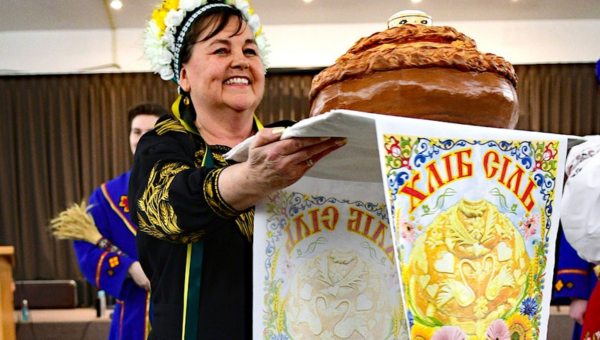
Andrea Malysh is the artistic director of the Sadok Ukrainian Dance Ensemble and the President of the Ukrainian Canadian Congress Thompson Okanagan Branch
By Andrea Malysh, Keremeos Review
Welcome to our corner of Ukrainian Connection.
I was inspired to write this column by Tom Skinner’s Celtic Connection. Thanks Tom!
The Okanagan has been home to Ukrainians post First World War and internment.
In fact, during the First World War internment of Ukrainians and others, Vernon had one of the largest internment camps in Canada and the longest running camp.
Ukrainians were used as forced labour to build British Columbia’s infrastructure which included Highway 6 from Cherryville to Edgewood and Highway 97A along Mara Lake, among other road building projects.
Ukrainian Catholic and Ukrainian Orthodox Churches were also established in the Thompson Okanagan region at this same time and still exist today in Kamloops, Grindrod, Vernon, and Kelowna.
The Thompson Okanagan region currently has over 20,000 Canadians who identify as having Ukrainian heritage.
The Sadok Ukrainian Dance Ensemble of Vernon (under the artistic direction of Andrea Malysh) has been performing in the Okanagan Valley and beyond for over 25 years.
They host the annual Okanagan Ukrainian Festival every May in Vernon.
Sadok has performed with the North Okanagan Pipes and Drums on a number of occasions. Both the Celts and Ukrainians share the same Patron Saint, St. Andrew.
Sadok welcomes new dancers for their fall dance season starting in September.
Sadok is also available for performances throughout the Thompson Okanagan Valley region for weddings, corporate events, and family reunions, among others. Contact [email protected] or visit www.sadok.net.
Since Russia’s full-scale invasion of Ukraine in February of 2022, Sadok has raised over $35,000 for the Canada-Ukraine Foundation Humanitarian Aid Fund for Ukraine.
As the war rages on in Ukraine, Sadok wishes to thank those who donated towards the much-needed humanitarian aid. Donations are always welcomed.
The Ukrainian Canadian Congress Thompson Okanagan Branch (UCC TO) was formed in order to facilitate the needs of newcomers from Ukraine through the Canada-Ukraine Authorization for Emergency Travel (CUAET) program, a temporary special measure introduced by Canada in March 2022 to provide expedited travel and stay options for Ukrainians and their family members fleeing the war in Ukraine.
UCC TO branch is pleased to announce that they are the recipients of a Wellness Program grant from the Canada-Ukraine Foundation. Federal funding was provided to assist newcomers arriving to Canada under the CUAET program.
The Thompson Okanagan Region has welcomed thousands of newcomers who have settled and are working in our communities.
This Wellness Program is to support mainly women and children who may require trauma counselling. It includes financial assistance for transportation costs to/from appointments, and childcare financial support during counselling sessions.
UCC TO supports a number of other initiatives including the Ukrainian library shelf at the Okanagan Regional Library; Ukrainian Language School for children and will be starting Conversation Circles in the region to assist adults with English language communication skills. For more information email [email protected].
UCC is the voice of Canada’s Ukrainian community. The Congress brings together under one umbrella all the national, provincial and local Ukrainian Canadian organizations. Together with its member organizations, the UCC has been leading, coordinating and representing the interests of one of Canada’s largest ethnic communities (1.4 million) since 1940 and has been instrumental in shaping Canada’s social, economic and political landscape. Visit ucc.ca for more information.
Andrea Malysh is the artistic director of the Sadok Ukrainian Dance Ensemble and the President of the Ukrainian Canadian Congress Thompson Okanagan Branch